

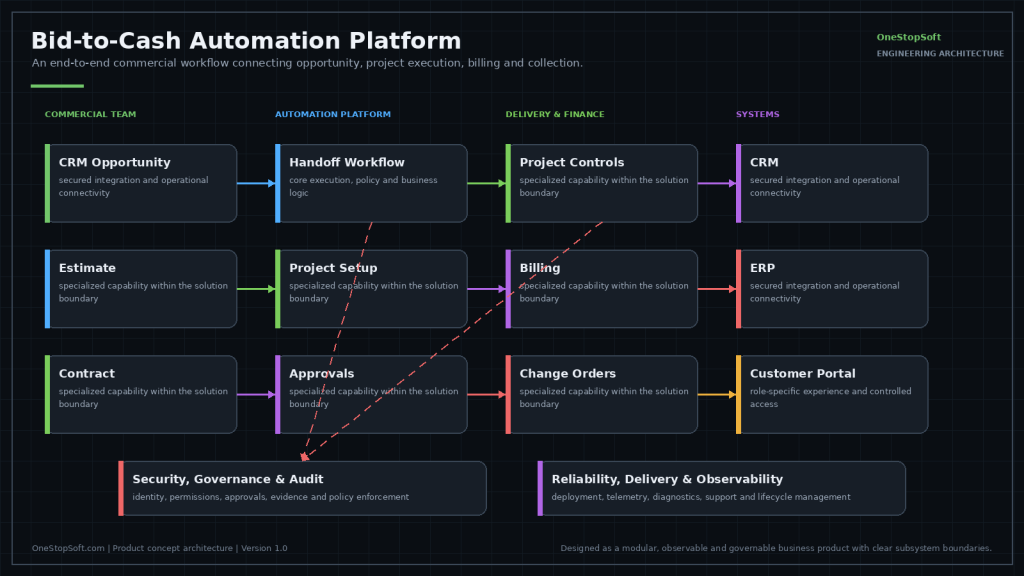
The gap between winning work and getting paid for it is where most contracting margin quietly disappears. The estimate is re-typed into a project. The change order is agreed verbally and invoiced late, or never. Retainage is tracked in someone’s head. By closeout nobody can reconcile what was sold against what was delivered.
Status: product concept, in active development. This is something we are building, not something you can buy today. We publish our roadmap because the engineering thinking behind it is the useful part — and because we would rather show you the design than imply a finished product.
Designed Capabilities
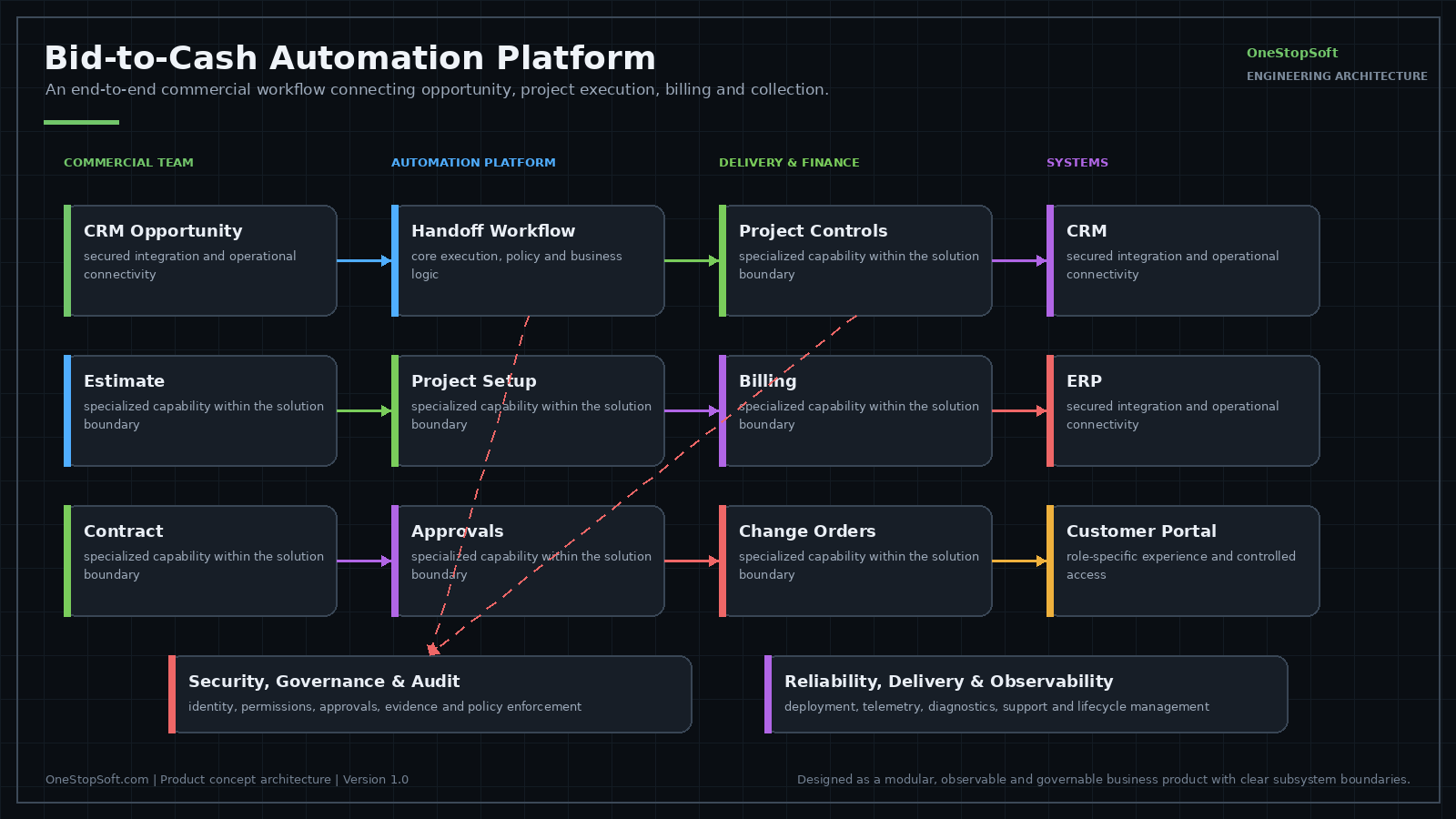
- Opportunity and estimate intake — the commercial record starts once and persists.
- Contract and scope handoff — what was sold arrives intact at the delivery team.
- Project and budget creation — generated from the contract, not rebuilt from it.
- Procurement and resource initialization — long-lead items identified at handoff.
- Billing schedule and retainage — tracked structurally rather than remembered.
- Change-order management — connected to the original contract and the invoice.
- Closeout and customer acceptance — documented and signed.
- Invoice, payment and revenue reporting — the whole chain reconcilable.
One Thread From Sale to Cash
Every handoff in this chain is a place where information is retyped and margin leaks. Keeping one connected record from opportunity through collection is unglamorous, and it is usually worth more than any single productivity feature.
Tell us if this matches a problem you have — early input shapes what we build first, and we will give you an honest view of where it stands.
Related services
- Business Process Automation — Quote-to-invoice work we deliver today: business process automation.
What Breaks Between the Estimate and the Project?
The estimate is built in the structure an estimator thinks in: assemblies, takeoff quantities, labor units. The project is run in the structure a project manager and an accountant think in: cost codes, phases, budget lines. Those structures rarely match, so someone maps one onto the other by hand, once, in a hurry, and every cost report afterward inherits whatever they decided that afternoon.
The mapping is the artifact worth designing. When estimate assemblies have an agreed home in the cost code structure, the budget can be generated from the sold work and variance means something. Without it, the project opens with a number nobody can trace.
What Is Buildable Now, and What Is Still on Paper
The Bid-to-Cash Automation Platform does not exist as a product. You cannot buy it, license it, pilot it or schedule it. The parts of it that are conventional integration work, connecting estimating, CRM, project tracking and accounting so one record survives each handoff, are things we deliver now under CRM and ERP Integration and Business Process Automation.
Change Orders Are an Evidence Problem
A disputed change order is settled on the record of authorization: whether the change was approved, by whom, when, and against what scope. A system helps only when capturing that evidence is faster than skipping it, which means a photo, a name, a timestamp and a scope note attached to the original contract at the moment of the conversation.
Any workflow that requires a field lead to return to a desk to record an approval will be used inconsistently, and inconsistent evidence is close to no evidence when the closeout meeting comes.
Retainage and Progress Billing Deserve a Design
Retainage is easy to bill and easy to forget. It sits on closed jobs, accrues quietly, and ends up tracked outside the accounting system by whoever noticed the problem first. Progress billing has a similar shape: your customer may require a specific format, backup documentation and lien paperwork before anything moves, and the format is set by them.
Anything you buy or build should treat held retainage as a visible balance with an owner and a next action. Ask to see that view during a demo.
What the Design Assumes
Long-running contracts, staged billing, change orders and retainage. Strip those out and much of what makes this valuable becomes overhead you would be maintaining for its own sake.
If the business is mostly time and materials, invoices go out weekly, and jobs close quickly, the sale-to-cash chain is short enough that a spreadsheet and a disciplined bookkeeper will hold it together.
Frequently Asked Questions
What is the Bid-to-Cash Automation Platform, and what is it not?
It is a design for one commercial record that persists from opportunity and estimate through contract, budget, billing, change orders and collection, so the same identifiers survive each handoff instead of being retyped. It is not an estimating package and is not designed to replace takeoff or assembly pricing. It is not a general ledger and is not designed to hold the books of record. It is not a document repository. It is not a field productivity app aimed at daily logs or time capture. The platform itself cannot be installed or deployed today.
What is it designed to connect to, and what has to already exist on the customer's side?
The design assumes four things the customer already owns and already runs: an estimating system that can export assemblies with quantities and dollars, a CRM holding the opportunity, an accounting or ERP system that owns the cost codes and the general ledger, and a project tracking system. The platform is designed to sit between them, not to replace any of them. In practice each of those systems needs either an API or a supported scheduled export, and a stable identifier that can be used as a key: an opportunity ID, a job number, a cost code. Where a system offers neither, the handoff it participates in cannot be automated, and the design treats that as a stated boundary rather than something to route around with screen scraping.
How is it designed to integrate with an accounting system without taking the books over?
The accounting system stays the system of record for cost codes, the general ledger, invoice numbers and AR. Anything the platform holds is designed to be derived from that: it reads the cost code list, maps estimate assemblies onto it, and writes back only records accounting already expects, such as a budget line, an invoice or a change-order amount. Direction is the part that matters. Records with an accounting consequence are designed to move in one direction only, from the platform into accounting or not at all, because two systems that both believe they own an invoice number create reconciliation work rather than removing it.
In what order is a rollout designed to proceed?
There is no rollout that can be scheduled; the following is design intent for whenever it is built. The cost code structure is agreed first and mapped from a real closed job, since the mapping between estimate assemblies and cost codes is the artifact everything downstream inherits. Connections come next in read-only form, with a finished job reconciled end to end so that existing disagreements between systems surface before anything is automated. Writing follows, in one direction only and limited to a single handoff, usually contract to budget, because that output is the easiest to check against a project that already exists. Billing schedule and retainage are configured only once budgets generate correctly, since a pay application built on a budget nobody trusts inherits the same problem. Field change-order capture is last, because it depends on people rather than connections and it needs correct contract and scope records for evidence to attach to.
How is change-order capture designed to work when the field has no signal?
Capture is designed to complete on the device and queue locally, so the record exists before any network round trip and a dead zone cannot be the reason an approval went unrecorded. The capture timestamp is stored separately from the sync timestamp, because what a dispute turns on is when the conversation happened, not when the phone found a tower. After a record syncs, corrections are designed to be appended rather than overwritten, so the original entry, the correction and the person behind each remain readable. An evidence record that can be quietly edited is worth considerably less in a closeout meeting than one that shows its own history.
How are retainage and progress billing handled in the design?
Held retainage is designed as a visible balance with an owner and a next action, carrying the amount, the contract clause it derives from and the job it sits against, rather than as a calculated field that only exists on individual invoices. AIA-style progress billing runs on a schedule of values: the G702 application summarizes the period, and the G703 continuation sheet carries the line-by-line breakdown of scheduled value, work completed previously, work completed this period, stored materials and retainage. Retainage is commonly held as a percentage of each line rather than of the invoice total, and contracts often reduce or stop the hold at a completion milestone. The design intent is that the schedule of values is derived from the same cost code structure the budget uses, so a pay application and a cost report are describing the same job.
Where does the data live, and what stays under the customer's control?
The design intent is that the platform holds very little the customer's own systems do not already hold. Cost codes, invoices and job financials stay in the accounting system. Documents are designed to be referenced where they already sit, in the existing document repository or SharePoint library, so the permissions that apply are the ones already set on the folder rather than a second set of rules that drifts from the first. Access is designed to run through the customer's existing identity provider instead of a separate user list, so removing someone from the directory removes their access everywhere at once. Connections use service accounts the customer creates, owns and can revoke unilaterally. Field photos and signatures are the one genuinely new class of data, and the design keeps them in the customer's repository as well, so nothing about closeout evidence depends on continued access to a vendor system.
What would a customer have to provide or decide?
Mostly decisions rather than infrastructure, and most of them are ones a contractor already has an implicit answer to. Which cost code structure is authoritative, and who owns changes to it. How estimate assemblies map onto that structure, plus one closed job to test the mapping against, since a mapping that has never been checked against a real job is a guess. Who can approve a change order in the field, and up to what dollar value. Who is accountable for producing lien waivers, and by what point in the pay application cycle they have to exist. Whether held retainage belongs to project management or to accounting, and therefore who chases it at closeout. Which system wins when two of them disagree. And service accounts with the API access each connection needs.